

The Great Leap Backward
Who promoted and supported Mao?

This essay’s title derisively refers to the notorious Great Leap Forward (1958-1961) as the Great Leap Backward. But China’s Great Leap Forward is not the ultimate object of my scorn. That scorn is reserved for the contemporary project conducted by people, who, if they knew anything about history, or cared about its results, would never propose this treacherous and potentially world-devastating campaign called the Great Reset—unless their intentions are evil and not merely misguided.
Meanwhile, I’m not the first to think of this appellation in connection with Mao’s Great Leap. That distinction may be held by a Soviet critic of Mao’s quixotic strategies. In an article entitled “The Great Leap Backward,” one A. Khan’kovskiy treated the Great Leap Forward as a major deviation from the “successful” Soviet socialist system that had followed “the Great October Socialist Revolution.”1
According to the Soviet writer, Khan’kovskiy, the Soviets had undertaken their glorious revolution under unfavorable conditions. They had established a socialist state against “the united front of the imperialist powers.”2 (Meanwhile, the Soviets were launched and kept afloat by Western—especially U.S.—financing and technology.3) In spite of these difficulties, the Soviets had set the standard and vouchsafed to the Chinese a blueprint and model that it might follow. In the case of China, “[t]he gigantic might of the Soviet state was on its side.” The Chinese benefitted from Soviet support as the Soviets treated the Chinese like a doting parent would its child. They had sent manpower, intelligence, material supplies, and money:
Our country gave China economic and political aid: For many years an entire army of Soviet specialists—over 10,000 people—worked in China. They helped build factories, automotive vehicle, tractor and machine building plants, electric power stations, radio stations, mines, bridges (the famous bridge across the Yangtse) River, highways...4
Even American politicians had acknowledged the Soviet Union’s largesse. According to Khan’kovskiy, a joint commission of the U.S. Congress wrote in a two-volume treatise on the Chinese economy: “history is unaware of a similar example in which a country [the Soviet Union] would offer on a plate an entire industrial system.”5
With Soviet assistance and funding, the Chinese began to trudge the road of happy destiny. In the first several years since the establishment of the Chinese People’s Republic, Chinese economic output had increased by several factors. From 1949 to 1957, as noted by the U.S. congressional commission, the index of industrial production of the Chinese People’s Republic rose by over 400 percent. China was on track to become another “successful” socialist state. For China, “[a]ll possibilities existed for a progress toward communism, following the true and tried way laid by the Great October Revolution.”6
Mao’s Early Career
In addition to the Soviet Union’s aid to Communist China, Mao benefitted personally and politically from Western and Eastern European assistance. Mao had been supported in his early communist career by Yale University vis-à-vis Yale-in-China.7 As Jonathan Spence, a professor of Chinese history, put it:
In 1919, Mao, aged 26, was in Changsa, having his middle school education. He visited Peking and while there received his...serious introduction to communist theory in Li Ta-chao’s Marxist Study Group. Now, if he was to develop a reputation in socialist circles, he had to find a forum to propagate his views...At this crucial point the student union of Yale-in-China invited Mao to take over the editorship of their journal.8
The Yale Daily News noted that Mao accepted the offer. With Mao at the helm, the paper would now be refocused to include social criticism of contemporary issues and work toward “thought reorientation.”9
After studying Marxist theory in Peking, Mao moved to Shanghai, where he met Ch’en Tu-hsiu, who later became the Communist Party leader. Ch’en instructed Mao to form an area branch of the party in Peking, but Mao found that he lacked the funds. Yale-in-China intervened again. Spence noted that “Yale-in-China agreed to rent him three rooms, which Mao named his ‘culture bookshop.’” Business boomed as Mao rang up “high sales” with such titles in Chinese as An Introduction to Marx’s Capital, A Study of the New Russia, and The Soviet System in China. Mao established branches of his bookstore and from the profits was able to establish several socialist youth corps and fund the Communist Party. Due to his success, Mao was chosen as one of the delegates to the 1st National Congress of the Chinese Communist Party at Shanghai in 1921. “From there it was only a small step to becoming one of the founders of the Communist movement in his country.”10
Yale-in-China was not the only foreign benefactor of the Chinese Communist Party (CCP) and its leader, however. Others included those who lived in and worked for the Communists in China: Grigorii Voitinski (born as Grigorii Naumovitch Zarkhin, leading Soviet Comintern emissary, “encouraged a group of [Chinese] intellectuals to establish the CCP, in secret”), Michail Borodin (born Mikhail Markovich Gruzenberg, leading Soviet Comintern emissary), Adolph Abramovich Joffe (Comintern emissary, Soviet ambassador to the official government in Beijing, 1922-1924), Pavel Mif (Comintern emissary, who also worked at the Foreign Languages Institute), Vladimir Abramovich Neumann (born Vladimir Abramovich Nieman, Comintern emissary), Boris Zakharovich Shumiatsky (Comintern emissary), David Crook (worked at the Foreign Languages Institute), Sidney Rittenberg (first American to become a CCP member, discussed below), Israel Epstein (editor-in-chief of China Reconstructs and member of the Chinese People’s Political Consultative Conference), Sidney Shapiro (worked at the Bureau of Cultural Relations with the Foreign Countries and the Foreign Languages Press), Solomon Adler (co-translator of Mao’s Collected Works into English), Sam Ginsbourg (worked on the translation of Quotations from Chairman Mao Tse-tung), and Michael Shapiro (co-translator of Mao’s Collected Works into English).11
Of special interest for our purposes is Sidney Rittenberg. Rittenberg represents what I have called a subversive elite. In an extensive obituary for The New York Times in 2019, Robert McFadden tells how Rittenberg became an intimate of Mao and a legendary figure in the Chinese Communist Party.12 Born to a prominent South Carolinian family, Rittenberg joined the American Communist Party in 1940, at age 19. Drafted into the military, he was forced to relinquish his party membership, and was trained in foreign languages at Stanford University. In his first (and last) U.S. military assignment, Rittenberg was sent to China to serve as a linguist for the Judge Advocate General.
Upon his discharge in 1946, Rittenberg joined a United Nations relief agency in Shanghai, where he met Communists who convinced him to join their movement. He undertook his own 45-day “long march” to Yan’an, where he met Mao in a mountain military sanctuary and became a member of the CCP, with Mao’s explicit endorsement. A translator of news dispatches for the party’s propaganda arm and an interpreter of Chinese for communiqués with international leaders, Rittenberg later became the head of China’s Broadcast Administration (Radio Beijing). As a leading propagandist, he promoted and glorified the Great Leap Forward and the Cultural Revolution:
Mr. Rittenberg was an avid propagandist during Mao’s Great Leap Forward, a campaign from 1958 to 1961 to transform China from an industrialized society…
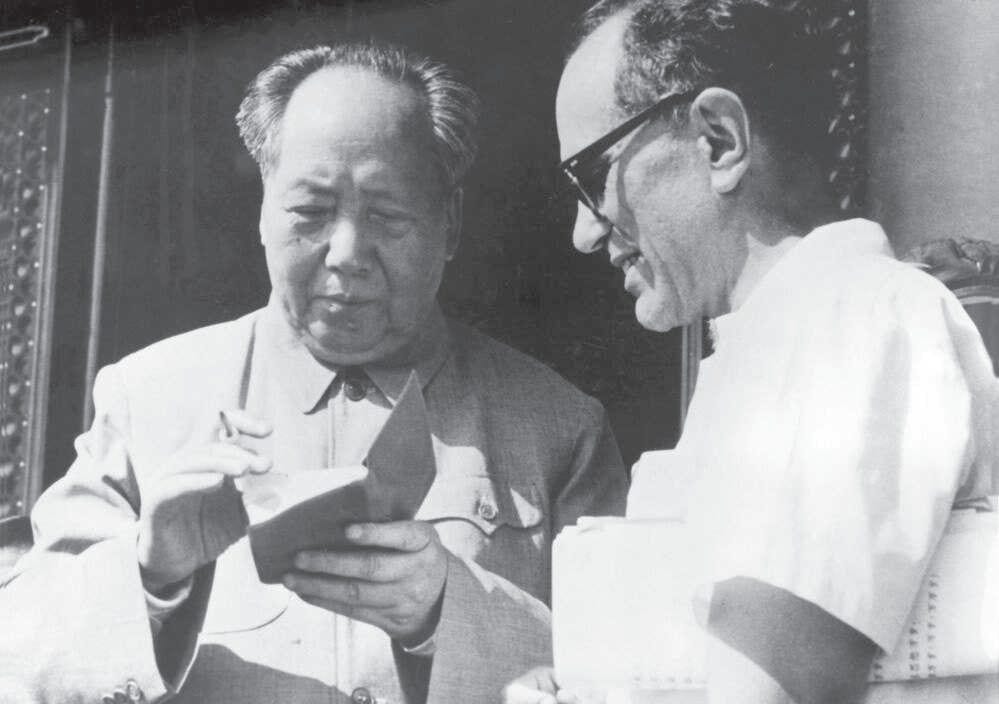
He was even more directly involved in the early stages of Mao’s Cultural Revolution, a decade-long purge of “bourgeois” intellectuals, party officials and others suspected of anti-Maoist thought. Starting in 1966, thousands of young Red Guards persecuted millions with imprisonment, torture, public humiliation and property seizures in struggles to create a Maoist cult of personality. Mr. Rittenberg joined the Red Guards in denouncing what they called “establishment” bureaucrats and haranguing the masses. His speeches and news conferences were published in the Red Guard newspapers. One famous picture from the era shows Mao autographing Mr. Rittenberg’s copy of his “Little Red Book” of sayings. Another shows Mr. Rittenberg on a speaker’s platform, holding the book up and exhorting crowds in Beijing’s Tiananmen Square to defend Mao’s thoughts.13
After serving a second prison sentence in China on the false charge of being a spy, Rittenberg, who still believed in the revolution, returned to the U.S. in 1979. He soon monetized his knowledge of the Chinese communist culture and the business community and helped Western corporations, especially Big Tech firms, to cash in on socialism with Chinese characteristics (or capitalism with Chinese characteristics).14 As such, he contributed to China’s developing market economy while subverting elements of the U.S. business establishment, especially the technology sector, which became beholden to the ideologically communist country.
But I digress.
Mao’s Madness
Khan’kovskiy suggested that Mao’s “voluntarism”15 soon got the better of him. The 8th National Congress of the Chinese Communist Party was held in 1956. The Congress approved the proposals for the second Five-Year Plan for 1958-1962. “There was no question of any adventuristic ‘leaps’ or of ‘communes.’”16 But the Maoists dismissed this original plan, as Mao decided to accelerate development radically. “The Maoists simply threw it overboard, replacing a more or less efficient program with high sounding phrases of ‘great leaps’ and ‘red banners.’”17
A second session of the 8th National Congress of the Chinese Communist Party was convened in May 1958. At this convention, Mao introduced his new revolutionary scheme. “The shrieking slogan which all of Mao’s stooges soon began learning by rote was: ‘By tensing all our forces, by striving forward, let us build socialism on the principle of more, faster, better and more economically!’”18 Mao aimed “to have China reach the production levels reached by the capitalist countries in the course of 100 to 200 years, in 10-20 or even less years.”19
The Great Leap Forward was an attempt to increase crop yields dramatically and to industrialize the countryside—to make local communities self-sustaining while increasing agricultural and industrial yields for the state. To accomplish these feats, the peasants were reorganized into massive communes of thousands and even tens of thousands, where all resources were communally shared, including food. Private ownership of land and free trade were abolished, along with the right to leave the collective.20 To avail women for farming, communal dining halls were established. With women working the communal farms, many men were likewise made available for small-scale “industrial” production. Communes were instructed to produce steel in homemade, backyard furnaces. A massive campaign to collect metal tools to transform everything into steel was conducted. Khan’kovskiy mockingly described this effort:
The Maoists intended to catch up with Britain by creating thousands and thousands of dwarf blast furnaces. It has been described already how everywhere, in cities and villages, on squares, streets and deserts, everywhere ore was to be smelted.21
On the agricultural front, to justify the over-seeding of land, “Mao had proclaimed his belief that ‘in company grain grows fast; seeds are happiest when growing together’—attempting to impose class solidarity on nature.”22 Seeds were sown at five to ten times the normal density, with the predictable result that many young plants were choked off and died. The Chinese adopted farming methods from the Soviet “agrobiologist,” Trofim Lysenko, a neo-Lamarckian who rejected Mendelian genetics and instead held to the Lamarckian inheritance of acquired characteristics. The results were disastrous:
Wheat and maize never grow well together in the same fields, and the replacement of the traditional barley crop with wheat in the high, cold fields of Tibet was simply catastrophic. Other mistakes were made in the nationwide campaign. The extermination of the sparrows that ate the grain resulted in a massive increase in the number of parasites. A large amount of hydraulic equipment that had been hurriedly and carelessly built was found to be useless or even dangerous because of the increased erosion and the risk of flooding at the first high tide. Moreover, the cost of its construction in terms of human life had been enormous: more than 10,000 out of 60,000 workers had died on one site in Henan.23
The peasants exhausted themselves in everything but agriculture, having been drafted into engineering projects and small-scale steel production, the products of which were virtually worthless. As Khan’kovskiy put it, Mao had turned “millions of experienced grain growers into amateur metallurgists.”24 The mismatch of competence and assigned duties represented a devastating loss in productive output.
The Black Book of Communism, reviled by Western Marxists, sardonically described the overall efforts as follows:
In this happy dream that was to bring real Communism within reach, the accumulation of capital and a rapid rise in the standard of living were to go hand in hand. All that had to be done was to achieve the simple objectives set by the Party.25
When the crop yields fell and the death toll rose, the Maoist regime began a campaign of denial, doublespeak, torture, and mass murder. The secretary of the Xinyang district wrote: “The problem is not that food is lacking. There are sufficient quantities of grain, but 90 percent of the inhabitants are suffering from ideological difficulties.”26 Sound familiar?
There is much more to this history. Suffice it to say that the Great Leap Forward precipitated the worst famine in recorded history. Deaths attributable to the famine of 1958-1961 numbered between 20 and 43 million, including those children who were murdered, boiled, and turned into fertilizer.27
The Ultimate Leap Backward
Whereas the Great Leap Forward was a misguided attempt to increase crop yields dramatically and industrialize the countryside, the Great Reset aims deliberately at deindustrialization and will effect a reduction in agricultural output. The Great Leap Forward established the People’s Commune and enforced collective “ownership” of land and other resources. Great Reset-initiated policies will lead to the consolidation of farmland in the hands of fewer owners, those with sufficient capital to undertake agriculture under stifling regulations and policies to meet Agenda 2030’s sustainable development goals (SDGs). Whereas during the early phase of the Great Leap Forward, eating meat was celebrated as a revolutionary act,28 under the Great Reset, eating meat is deemed reactionary and unsustainable while eating insects and synthetic meats is promoted and celebrated as environmentally conscious.29 The putative object of the Great Leap Forward was to increase gross domestic product to equal or surpass that of developed nations, particularly Great Britain, and to raise the standard of living of the peasants and the population at large. The Great Reset, on the other hand, represents deliberate de-growth and reduced standards of living of the lower and middle classes in the developed world and the squelching of growth in the developing world. While the Great Leap Forward was implemented to hasten the arrival of full communism, the Great Reset establishes corporate socialism, economic fascism, and neo-feudalism. Despite the technological innovations of the Fourth Industrial Revolution, the Great Reset is a de-civilizational project.
Yet, the Great Leap Forward and the Great Reset share one essential feature: the arbitrary imposition of a collectivist unscientific ideology on all human activity and nature. During the Great Leap Forward, Lysenkoism was adopted from the Soviet Union for ideological reasons, despite its disastrous effects there. During the Great Reset, climate catastrophism has been adopted on equally ideological, unscientific grounds. “The science” we are told to follow is a sham. Against the facts of science and the benefits of technology, we are told that CO2 is pollution, that “sustainability” requires imposing an enormous tax on humanity for the respiration of plants, and that farming methods of the original Green Revolution, which have increased yields by many factors, must be eliminated and replaced with a new environmentalist Green Revolution. We are told that industrial production must be carried on using non-fossil-fuel inputs. These demands are as delusional as anything advocated by Chairman Mao.
Carbon neutrality by 2050 is an insanely impossible demand. Our industrial civilization and the population it supports depend on the advances made in fossil fuel extraction and use. Even Vaclav Smil, a believer in climate change, who is an otherwise credible source, agrees:
For those who ignore the energetic and material imperatives of our world, those who prefer mantras of green solutions to understanding how we have come to this point, the prescription is easy: just decarbonize—switch from burning fossil carbon to converting inexhaustible flows of renewable energies. The real wrench in the works: we are a fossil-fueled civilization whose technical and scientific advances, quality of life, and prosperity rest on the combustion of huge quantities of fossil carbon, and we cannot simply walk away from this critical determinant of our fortunes in a few decades, never mind years.
Complete decarbonization of the global economy by 2050 is now conceivable only at the cost of unthinkable global economic retreat, or as a result of extraordinarily rapid transformations relying on near-miraculous technical advances.30
In short, we risk returning to the pre-industrial era of drudgery and intermittent starvation if the planners of the Great Reset have their way. They must not have their way.
A. Khan’kovskiy, “The Great Leap Backward,” Literaturnaya Gazeta, no. 36 (September 6, 1967): 14–15. Pages in the retrieved document do not maintain the original pagination. I will refer to the page numbers of the retrieved document.
Ibid., page 1.
Antony C. Sutton, Wall Street and the Bolshevik Revolution, Forest Row: Clairview, 2016; Antony C. Sutton, National Suicide: Military Aid to the Soviet Union, Dauphin Publications Inc., 2021.
Khan’kovskiy, “The Great Leap Backward,” page 1.
Ibid., page 2.
Ibid.
“Yale Group Spurs Mao’s Emergence,” Yale Daily News, February 29, 1972, page 1.
Spence qtd. in ibid.
Ibid.
Ibid., Spence qtd. in ibid.
Yitzhak Shichor, “Combining Contradictions: Jewish Contributions to the Chinese Revolution,” International Journal of China Studies 11, no. 2 (December 2020): 183–212.
Robert D. McFadden, “Sidney Rittenberg, Idealistic American Aide to Mao Who Evolved to Counsel Capitalists, Dies at 98,” The New York Times, August 25, 2019, https://www.nytimes.com/2019/08/24/world/sidney-rittenberg-dead.html.
Ibid.
Gary Rivlin, “A Long March from Maoism to Microsoft,” The New York Times, December 5, 2004, https://www.nytimes.com/2004/12/05/business/yourmoney/a-long-march-from-maoism-to-microsoft.html.
In Marxist thought, voluntarism refers to an overemphasis on the subjective conditions (will, consciousness) for revolution. It deviates from the orthodox Marxist position, which emphasizes “objective conditions,” which are deemed to be determinative.
A. Khan’kovskiy, “The Great Leap Backward,” page 2.
Ibid.
Ibid., page 3.
Ibid.
That is, the property rights of the peasantry were completely abrogated, the first instance of which is ownership of oneself.
A. Khan’kovskiy, “The Great Leap Backward,” page 4.
Stéphane Courtois and Mark Kramer, The Black Book of Communism: Crimes, Terror, Repression, Cambridge, MA: Harvard University Press, 2004, page 489.
Ibid.
A. Khan’kovskiy, “The Great Leap Backward,” page 4.
Stéphane Courtois and Mark Kramer, The Black Book of Communism, page 488.
Qtd. in ibid., page 492.
Ibid., pages 492-493.
Ibid., page 488.
See for example, Amrou Awaysheh and Christine J. Picard, Ph.D., “5 Reasons Why Eating Insects Can Reduce Climate Change,” World Economic Forum, February 9, 2022, https://www.weforum.org/agenda/2022/02/how-insects-positively-impact-climate-change/; Kate Whiting, “How Soon Will We Be Eating Lab-Grown Meat?” World Economic Forum, October 16, 2020, https://www.weforum.org/agenda/2020/10/will-we-eat-lab-grown-meat-world-food-day/.
Vaclav Smil, How the World Really Works: The Science Behind How We Got Here and Where We’re Going, Viking, 2022, https://www.amazon.com/How-World-Really-Works-Science/dp/0593297067, pages 5-6.
G’day Michael, Thanks for this post. I recall reading this before. Is this an extract from one of your books?
In any event, a couple things. This piece highlights the significant influence of our “Hebrew” brethren in the establishment of Communist China and its ongoing trajectory thereafter (including the GLB/GLB and the so-called “Cultural Revolution”), a tumultuous history to be sure which unfolded at a monumental cost. I don’t believe that there as many people as aware of this Jewish influence as they are of same in the Soviet Union. Say what you will about the “Chosen Ones”, but in the broad historical firmament they get around, and are not shy about ‘spreading the love’ in their travels.
Also I found the following statement puzzling: “Even American politicians had acknowledged the Soviet Union’s largesse. According to Khan’kovskiy, a joint commission of the U.S. Congress wrote in a two-volume treatise on the Chinese economy: ““history is unaware of a similar example in which a country [the Soviet Union] would offer on a plate an entire industrial system.””
Could not the same be said of American and Western largesse toward the Soviet Union itself in the development of its own industrial system, one which was documented in particular by Antony Sutton in his book The Best Enemy Money Can Buy. Which begs the question (amongst many others) as to whose “largesse” it was originally? Not to mention that other hardy historical conundrum: Just who exactly were the good guys and who were the bad guys?
China: the new j<<ish mafia's global military enforcer.
Mamdani, Hinkle and ilk are communists on the j<<ish plutocrats' payroll.
A part of pushing the j<<ish-'Chinese' technocratic communism 2.0 on America and the West (digital gulag).
https://tir1.substack.com/p/china-the-jish-mafias-new-global?r=qw38a&utm_campaign=post&utm_medium=web&showWelcomeOnShare=true